
In this guide
- What is life insurance? (Life insurance kya hota hai?)
- What is LIC, and why does it matter?
- Do you need life insurance? The 3-question family test
- Types of life insurance in India, compared
- Term insurance vs endowment plans (including LIC): same money, very different protection
- How much life insurance do you need? Make your family money map
- How long should your policy run?
- How to choose the best life insurance plan for your family: 7 steps
- 8 mistakes that leave families unprotected (and get claims rejected)
- Life insurance claim process: what your family must do
- Protect the payout: nominee, MWP Act and a family file
- Life insurance tax benefits (check the current rules)
- Frequently asked questions
- Need help? Talk to us
What is life insurance? It is a promise. If you die while your policy is active, the insurance company pays your family a fixed amount of money. For most families, the best start is a term insurance plan. Its cover should be about 10 to 15 times your yearly income, plus your loans.
This guide explains life insurance in India in plain words. You will learn what life insurance is, whether you need it, and how to work out your number. You will also see how to choose a plan, and what to do so your family's claim is paid without trouble.
What is life insurance? (Life insurance kya hota hai?)
Life insurance replaces your income for your family if you are no longer there. You pay a small, regular amount. In return, the insurer promises a large amount to your family if you die during the policy period.
5 benefits of life insurance
- Your family's income continues. The payout replaces the money you would have earned.
- Loans do not fall on your family. A home loan or business loan can be paid off.
- Your children's goals stay on track. Their education and marriage can still be funded.
- It is cheapest when you are young. The premium you lock in stays the same for the whole term.
- Extra benefits. Some plans also build savings or allow a loan against the policy, and there may be tax benefits (see below).
The words you will hear (and what they mean)
| Word | What it means in simple words |
|---|---|
| Premium | The amount you pay to the insurer, every month or every year. |
| Sum assured | The amount your family gets if you die. This is your "cover". |
| Policy term | How many years the policy protects you, for example 30 years. |
| Nominee | The person who receives the money. Usually your spouse, child or parent. |
| Maturity benefit | Money paid to you if you are alive when the policy ends. Only some plans give this. |
| Rider | An extra cover you add to your policy for a small extra premium, such as accident cover. |
| Free-look period | A short window after you get the policy when you can cancel it and get your money back, minus small charges. |
How it works: a simple example
Example only. Amit is 30 and buys a term plan with a sum assured of ₹1 crore for 30 years. He pays the same premium every year. If Amit dies at 45, his wife (the nominee) receives ₹1 crore. If he lives past 60, the policy simply ends. He paid for 30 years of peace of mind, like paying for a helmet you hope never to need.
What is LIC, and why does it matter?
Many people in India say "LIC" when they mean life insurance. But LIC is the name of one company: the Life Insurance Corporation of India.
- Who owns it: LIC was set up by the Government of India in 1956, and the government is still its main owner.
- Size and reach: it is India's oldest and largest life insurer, with branches and agents in cities, towns and villages.
- Government guarantee: under the LIC Act, 1956, the Government of India guarantees the sum assured and bonuses on LIC policies. This is a big reason families trust it.
- Same rules as everyone: LIC is regulated by IRDAI, just like the more than 20 private life insurers.
Why LIC matters to Indian families
For generations, an LIC policy has been the first money step for millions of families. LIC's traditional plans, such as endowment and money-back plans, combine life cover with regular savings and bonuses. Its large branch network also puts help with service and claims close to home, even in small towns.
LIC or a private insurer?
| LIC | Private life insurers | |
|---|---|---|
| Owner | Government of India (main owner) | Private companies, often with a bank or foreign partner |
| Regulated by | IRDAI | IRDAI |
| Known for | Traditional savings plans, wide reach, government guarantee | A wide choice of online term plans, digital service |
| Where to buy | LIC agents, branches and LIC's website | Agents, brokers, banks and the insurers' websites |
Our advice: do not choose by the name alone. First decide how much cover you need, using the money map below. Then compare LIC and other insurers on cover, premium, claim record and service. You can see LIC's current plans on LIC's official website.
Do you need life insurance? The 3-question family test
Answer these three questions honestly:
- Does anyone depend on your income? This could be a spouse, children, or parents you support.
- Do you have loans? Think of a home loan, car loan, business loan or personal loan.
- Would your savings last if your income stopped tomorrow? Ask how many years they would last, not just months.
If you answered yes, yes or no to any of these, you need life insurance. The more yeses, the more urgent it is.

Who may not need it (yet): single people with no dependants and no loans, and retired people with enough savings. Children usually do not need life cover. They need health insurance instead.
Homemakers count too. A homemaker does not earn a salary. But the family would have to pay for childcare, cooking and running the house. Some insurers offer cover for homemakers, often together with the earning spouse's policy. Ask us about it.
Types of life insurance in India, compared
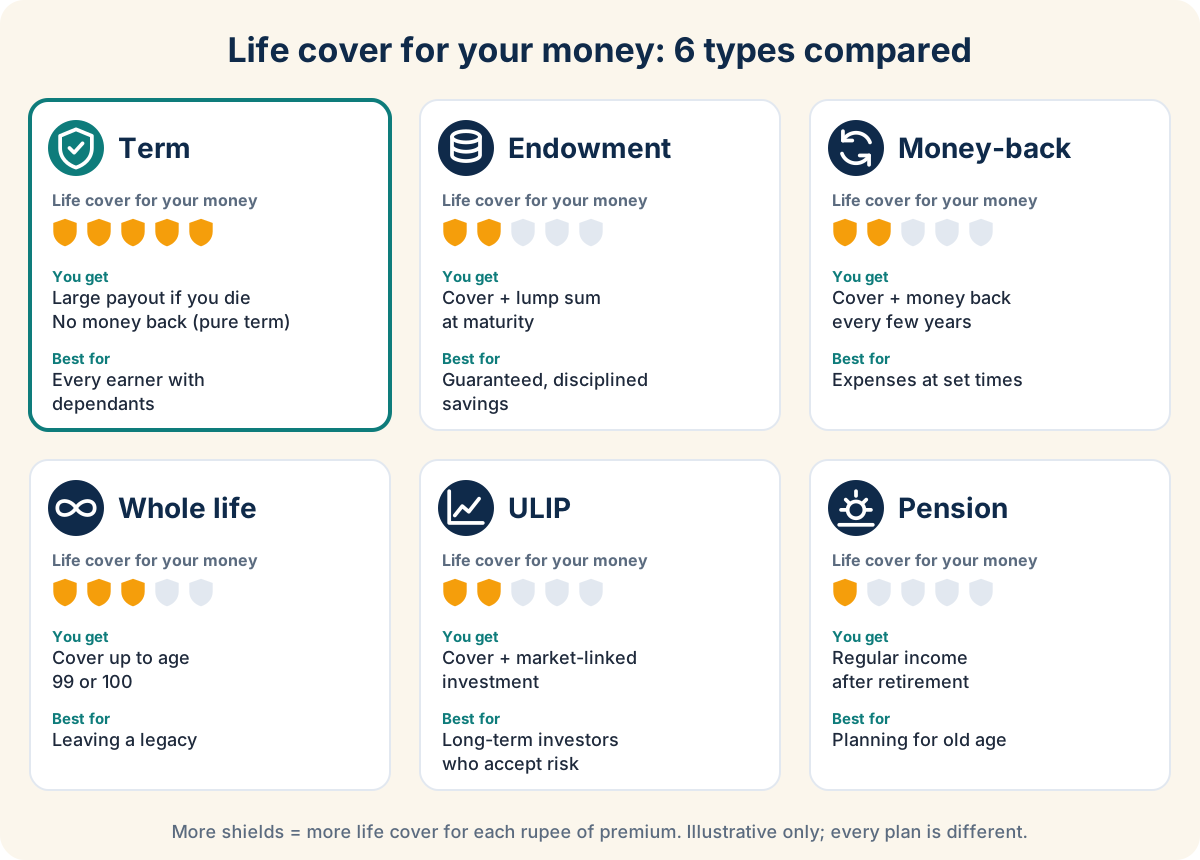
There are two big families of plans:
- Protection plans give a large cover for a low premium (term insurance).
- Savings plans mix a smaller cover with savings or investment (endowment, money-back, whole life, ULIP, pension).
Term insurance
Pure protection. You get the highest cover for the lowest premium. Nothing is paid if you survive the term. Some term plans return your premiums at the end, but they cost much more.
Endowment plan
Life cover plus savings. Your family gets the sum assured if you die. If you survive, you get a lump sum at maturity, often with bonuses. The cover is much smaller for the same premium.
Money-back plan
Like an endowment plan, but it pays back part of the money every few years, for example every 5 years. This suits people who want cash at set times. The cover is small for the premium.
Whole life plan
Cover for life, often up to age 99 or 100. It is useful if you want to leave money to your children, whatever age you die. The premiums are higher.
ULIP (Unit Linked Insurance Plan)
Insurance plus market-linked investment. Part of your premium buys life cover; the rest is invested in funds you choose. Returns go up and down with the market. There is a 5-year lock-in, which means you cannot take the money out for the first 5 years.
Pension (annuity) plan
These plans build a fund for retirement, then pay you a regular income, called an annuity. The main aim is income in old age, not protection for your family.
| Plan type | What you get | Best for | Life cover for your money | Watch out for |
|---|---|---|---|---|
| Term | Large payout if you die | Every earning person with dependants | Highest | No money back if you survive (in pure term) |
| Endowment | Cover + lump sum at maturity | People who want guaranteed, disciplined savings | Low | Returns are usually modest |
| Money-back | Cover + payouts every few years | Planned expenses at set times | Low | Small cover; check the total return |
| Whole life | Cover up to age 99/100 | Leaving a legacy | Medium | Higher premium for many years |
| ULIP | Cover + market investment | Long-term investors who accept risk | Low | Market risk, charges, 5-year lock-in |
| Pension | Retirement income | Planning for old age | Very low | Annuity income may be taxable |
Term insurance vs endowment plans (including LIC): same money, very different protection
This is the most important comparison in this guide. Look at what the same yearly premium buys.
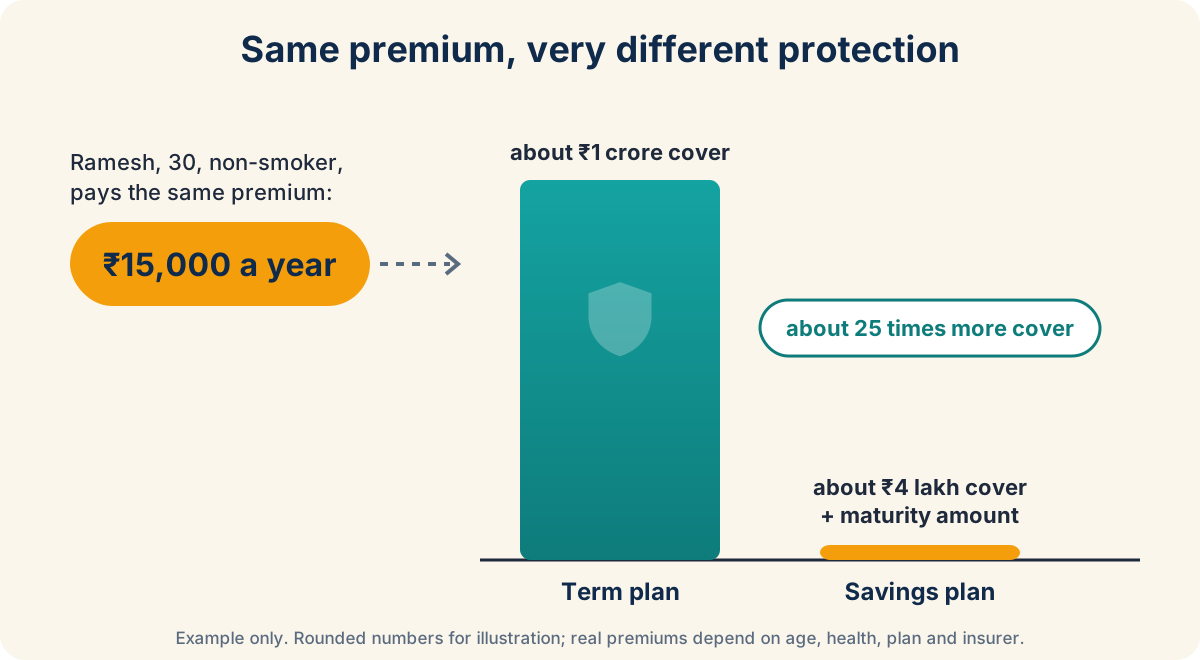
Example only. The numbers are rounded and for illustration. Real premiums depend on your age, health, habits, plan and insurer. Ask us for actual quotes.
Ramesh is 30 and does not smoke. He can spare about ₹15,000 a year.
- Option A, a term plan: about ₹1 crore of cover for 30 years.
- Option B, a savings (endowment) plan: about ₹4 lakh of cover, plus a maturity amount if he survives.
If Ramesh dies at 40, Option A pays his family ₹1 crore. Option B pays about ₹4 lakh plus any bonus, which could cover only a few years of expenses.
Our honest view: first make sure your family has enough protection, usually through a term plan. After that, if you want guaranteed savings, a traditional plan (such as an LIC endowment plan) can still have a place in your plan. Just do not let a savings plan replace the protection your family needs.
This is also the honest answer to a question we hear every week: "term insurance vs LIC, which is better?" LIC sells term plans too. What matters most is the type of plan, not only the company's name.
How much life insurance do you need? Make your family money map
This section answers the question many people search for: term insurance kitna hona chahiye? Your family needs enough money to live as they do today, and to finish what you planned for them. Follow these four steps.
- Replace your income. Multiply your yearly income by the number of years your family would need it. A simple rule of thumb: 15 times if you are under 30, 12 times in your 30s, 10 times in your 40s and 8 times in your 50s.
- Add your loans. This is why life insurance matters so much with a home loan: your family should not have to sell the house to repay it.
- Add big goals. Think of a child's higher education or marriage: things you want funded even if you are not there.
- Subtract what you already have. Count only your own existing life cover and savings set aside for these goals. Do not count life cover from your employer. It usually ends when you leave the job.
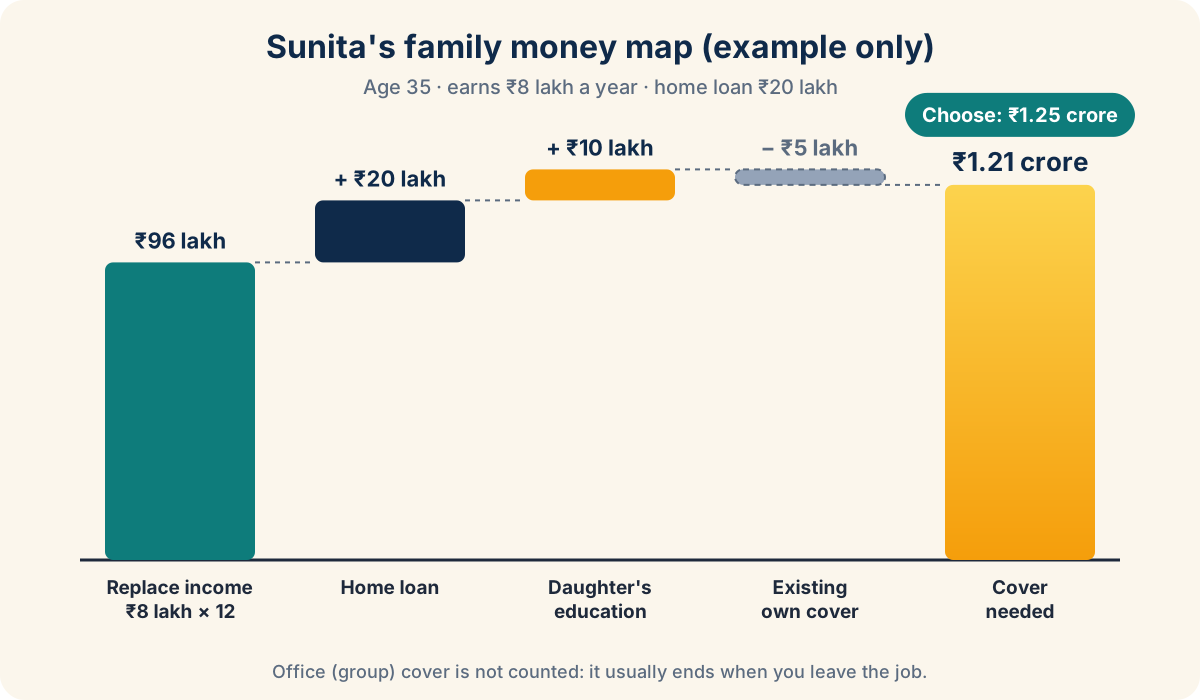
Worked example: Sunita's money map
Example only. Sunita is 35. She earns ₹8 lakh a year and has a home loan of ₹20 lakh. She wants ₹10 lakh kept for her daughter's education. She has an old personal policy with ₹5 lakh cover, and ₹10 lakh of group cover from her office.
| Step | Calculation | Amount |
|---|---|---|
| Replace income | ₹8 lakh × 12 years | ₹96 lakh |
| Add loans | Home loan | + ₹20 lakh |
| Add goals | Daughter's education | + ₹10 lakh |
| Subtract existing cover | Old personal policy (office cover not counted) | − ₹5 lakh |
| Cover needed | ₹1.21 crore → about ₹1.25 crore |
Want to try it with your own numbers? Use our free life cover calculator. It takes one minute.

How long should your policy run?
Your cover should last as long as someone depends on your income. Choose the later of these:
- The age when you plan to retire (often 60 to 65)
- The year your youngest child will be financially independent
- The year your biggest loan will be fully repaid
Buying younger keeps the premium low for the whole term. A plan bought at 30 usually costs much less every year than the same plan bought at 40.

How to choose the best life insurance plan for your family: 7 steps
- Decide your goal. Is it protection, savings, or both? Protection always comes first.
- Fix your cover amount using the money map above.
- Choose a premium you can pay every year for the full term. A policy that lapses in year 5 protects no one.
- Add only the riders you need. Useful ones are accidental death benefit, critical illness cover and waiver of premium, which means future premiums are waived if you become disabled or seriously ill.
- Check the insurer's claim settlement ratio. This is the share of claims an insurer pays. IRDAI publishes every insurer's claim settlement ratio in its annual report. Look at several years, not just one.
- Tell the full truth in your application. Disclose your health, smoking, alcohol, income and other policies. This is what makes the claim certain later.
- Read your policy document in the free-look period. If anything is different from what you were told, you can cancel and get a refund.
Ready to compare real options? Get a free term insurance quote. We compare plans for you and explain them in simple words.
8 mistakes that leave families unprotected (and get claims rejected)
- Too little cover. A ₹10 lakh policy feels big today. In 15 years, it may pay for only two or three years of household costs.
- Mixing insurance and investment and ending up with neither enough cover nor good returns.
- Hiding health problems or smoking to save on premium. This is one of the most common reasons life insurance claims are rejected.
- Relying only on office cover. It ends when you change or lose your job, often when you need it most.
- Not telling the family. Many policies are never claimed because nobody knew they existed.
- Letting the policy lapse. If you miss premiums, the cover can stop. Already missed some? Find out how to renew or revive your policy.
- Forgetting to update the nominee after marriage, divorce, or a death in the family.
- Waiting too long. Every year you wait, the premium goes up. A new illness can also make cover costly or impossible to get.

Life insurance claim process: what your family must do
A death claim is the request your nominee makes to the insurer after the policyholder dies. Here are the usual steps:
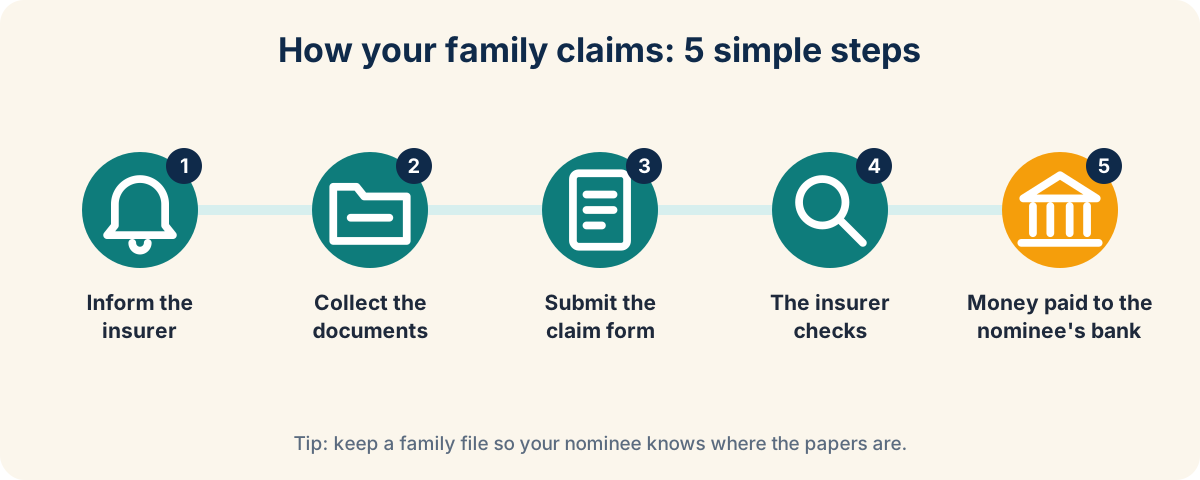
- Inform the insurer as soon as possible, by branch visit, website, phone or email.
- Collect the documents: death certificate, policy document (or its number), claim form, the nominee's ID and bank details, and medical or police papers depending on the cause of death.
- Submit the claim form with copies of all documents. Keep a copy and the acknowledgement.
- The insurer checks the claim. For older policies with no doubts, this is usually quick. IRDAI rules set strict time limits for insurers.
- The money is paid directly to the nominee's bank account.
If the insurer delays or rejects a claim unfairly, first complain to the insurer in writing. If it is not solved, you can use IRDAI's Bima Bharosa complaint portal or approach the Insurance Ombudsman.
You don't have to do this alone at a difficult time. We file the papers and follow up for you. Get help with a claim.
Protect the payout: nominee, MWP Act and a family file
Buying the policy is half the job. Make sure the money reaches the right people, quickly.
- Name a nominee and keep it up to date. You can usually split the amount between more than one nominee, in percentages.
- Consider the MWP Act. A married man can buy a policy under the Married Women's Property Act. The money then goes only to his wife and/or children. Creditors or other relatives cannot claim it, which matters if you run a business or have loans. This must usually be chosen when you buy the policy.
- Create a family file. Keep one folder, on paper and on the phone, that your family knows about. It should hold:
- A list of all policies, with the insurer, policy number and sum assured
- The policy documents, or copies of them
- Your adviser's name and phone number
- Where your ID, bank and property papers are kept
Life insurance tax benefits (check the current rules)
Life insurance has long had tax benefits in India. Treat them as a bonus, not the reason to buy.
- Premiums: under the old tax regime, premiums could be claimed as a deduction, together with other investments, up to a yearly limit. This was known for years as "Section 80C". The new tax regime does not allow this deduction.
- Death benefit: the amount paid to your family on death is generally tax-free.
- Maturity amount: this is tax-free only if certain conditions are met, such as limits on the premium. Policies with high premiums may be taxable.
Important: India's new Income-tax Act, 2025 applies from 1 April 2026, and many section numbers have changed. Rules also differ between the old and new tax regimes. Please check the current rules on the Income Tax Department website or with your tax adviser before you decide.
Frequently asked questions
What happens if I miss a premium?
You get a grace period: usually 30 days for yearly, half-yearly or quarterly payments, and 15 days for monthly payments. You stay covered during it. After that, the policy lapses. Most plans let you revive it within a few years by paying the dues, sometimes with a health check. See your policy for the exact rules.
Can I have more than one life insurance policy?
Yes. Many people combine an older savings policy with a newer term plan. You must tell each new insurer about your existing policies. On a claim, every policy pays its own sum assured.
Do I get my money back from a term plan if I survive?
Not from a pure term plan. That is why it is so affordable. "Return of premium" term plans do give your premiums back at the end, but they cost a lot more. Often it is better to buy pure term and invest the difference.
What is the best age to buy life insurance?
As soon as someone depends on your income, ideally in your 20s or early 30s. The premium you lock in when young stays the same for the whole term, and you are more likely to be healthy, which makes it easier to get cover.
What does life insurance not cover?
Most plans cover death from any cause, including illness and accidents. Common exclusions are suicide in the first 12 months, and deaths linked to risky activities named in the policy. Claims can also be rejected if important facts were hidden when buying. Read the exclusions in your policy document.
How long does a death claim take?
If the papers are complete and the claim needs no investigation, insurers usually settle it within days or a few weeks. IRDAI rules set maximum time limits, and delays beyond them can mean interest is paid to the nominee. You can check the current rules on the IRDAI website.
Need help? Talk to us
Choosing life insurance is a big decision, but it does not have to be confusing. We will:
- work out the right cover for your family, using your real numbers,
- compare suitable plans, including term life insurance and LIC policies and services,
- explain every term in simple words, and help your family when they need to claim.
Book a free call with Neeraj. No pressure, just honest advice.
Disclaimer: This article is for information only and is not financial, legal or tax advice. Insurance is the subject matter of solicitation. Plan features, benefits and tax rules vary and may change; read the policy document and sales brochure carefully before buying.